Racial purity and racial strength
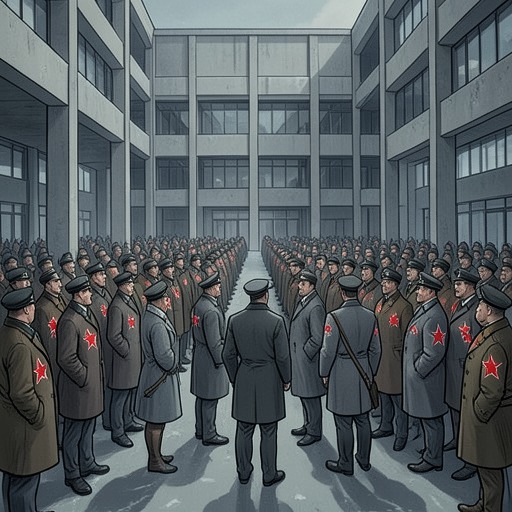
The Zone of InterestRacial purity and racial strength is the doctrine that treats racial separation as a biological law and political virtue, claiming that a people’s power depends on preventing intermixture. In the novel, the formula is voiced by Nazi officials as common sense, but its supposed evidence is conspiracy propaganda and its practical consequence is a system that exploits, deports, and murders the people it marks as enemies. The doctrine’s central trick is to present a political choice as nature: persecution becomes self-defence, coercion becomes necessity, and extermination can be discussed as administration.
The doctrine as racial common sense
At a gathering attended by Paul Doll, Baldemar Zulz gives the principle its bluntest formulation: “Racial purity equals racial might.” Paul Doll reinforces the claim by asserting that Jews understand this principle and do not intermarry. The exchange turns a political obsession into an alleged biological insight. The speakers cast Jewish people not as individuals but as a unified racial opponent, whose supposed discipline and strength are presented as a threat to Germany.
The accusation of racial purity sits beside a contradictory catalogue of alleged Jewish traits. Elsewhere, Paul Doll invokes the Reichsführer to claim that Jews are constitutionally averse to work, prone to evasion, and incapable of physical labour. In this account they supposedly grow rich by living off host populations, yet are also so dangerous that German wounded are said to be flayed. The claims do not need to cohere: both the imagined racial weakness and the imagined racial menace serve the same purpose, making hostility seem justified in advance.
Conspiracy presented as proof
The doctrine is upheld not through evidence open to examination but through a closed circuit of accusation. Paul Doll boasts that the regime has “the minutes,” and Baldemar Zulz identifies these as the Protocols of the Elders of Zion. When Angelus Thomsen raises the fact that some people doubt the document, Paul Doll answers by invoking Mein Kampf: because The Times calls the document a fabrication, he says, that is proof of its authenticity. The claim converts criticism into confirmation. No possible response can dislodge it, because disagreement itself is recast as evidence for the conspiracy.
That circular reasoning clarifies how the doctrine works in the novel. The supposed racial facts are not conclusions reached by observing people; they are premises imposed on them. Stereotypes of parasitism, evasion, and menace make exclusion appear protective, while the charge of Jewish racial solidarity makes the target seem powerful enough to warrant extraordinary measures. Trudel Zulz’s comparison of Jews to bloodsuckers and bedbugs gives the same logic a dehumanizing, bodily register: a population is imagined as a contaminant to be removed.
Racial doctrine inside a system of competing demands
The regime’s treatment of Jews also reveals a practical contradiction beneath its biological rhetoric. In his private reflections, Angelus Thomsen describes pressure from the Economic Administration Head Office to increase labour strength for the munitions industries, set against security authorities pressing for the disposal of as many evacuees as possible. The conflict is not between humane and inhumane policy: both demands belong to a system that treats Jewish lives as resources to use or obstacles to eliminate. A proposal to work able-bodied mothers until they collapse in a boot factory makes that logic concrete, as does Thomsen’s recognition that anyone attempting to separate mothers from their children at the ramp would face the consequences directly.
At Buna-Werke, the disparity between official priorities and lived conditions is visible through the office window. Prisoners in striped clothing hurry in lines or collide in a scrum, while Kapos, SS non-commissioned officers, and company foremen pass commands down the chain. Yet Angelus Thomsen’s attention settles on designers, engineers, and administrators from IG Farben plants, carrying leather-bound notebooks and measuring tapes as they pick their way around the wounded, unconscious, and dead. The scene sets the language of industrial productivity beside the human cost it excludes from its calculations. Racial ideology helps make that exclusion possible by turning people into a category—labour to be extracted, or a supposed racial danger to be disposed of.
From racial fantasy to mass murder
In a later conversation in the Tiergarten, Professor Entress places the machinery of killing within a broader history of decisions. He locates the beginning of what he calls “the crime without a name” in a letter dated July 31, 1941: drafted by Adolf Eichmann and Reinhard Heydrich, sent to Göring, and returned with his signature. The letter conveys Hitler’s wish for a total solution and authorizes action. Entress describes an initial possibility of deporting Jews to a barren region after a rapid victory over Russia, followed by pressure from officials in occupied Poland who said they could not cope with the numbers. As that territorial solution receded, he says, the decisive expansion was killing not only men but women and children.
Entress also refuses to let the gas chambers and crematoria stand for the entire history of the crime. He calls them means of speeding the killing, economizing, and sparing the nerves of the killers, not its underlying cause. The Einsatzgruppen, he says, had already killed well over a million people by bullets; bullets and pyres could have continued the work. His account places industrial methods within a larger murderous will. The racial doctrine does not itself explain every administrative turn, but it supplies a worldview in which the victim’s destruction can be made to seem both permissible and necessary.
The doctrine’s material and moral residue
The novel repeatedly makes the consequences of these abstractions physical. At the Old Town civic centre, local representatives tell Paul Doll that the water is undrinkable however often it is boiled, that the waste has begun to ferment, and that the water table has been breached. Doll predicts an unbearable smell; on the drive back, he keeps stopping to sniff the air as it worsens. At Buna-Werke, industrial personnel move through the same spaces as the wounded and dead. Such scenes do not equate pollution with racial persecution; they show a regime whose claims to order and strength coexist with material conditions it cannot contain.
That contradiction becomes an explicit moral reckoning in Paul Doll’s questions after the November 9 memorial luncheon. He asks why, if what they are doing is good, it smells so bad; why the meadow was made to churn and spit; and why conception and pregnancy in the camp promise death for mother and child. He connects the brown snow to a placard demanding obedience, then reads the corpse inside the word Kadavergehorsam as an image of both the dead and those who obey. The doctrine of racial strength is thus set against a world of death, waste, and spiritual desolation. Its grand claim to biological vitality ends in a system that destroys life and leaves even its obedient servants implicated in the ruin.